Hydrogen Through the Eyes of an Expert: Jan Žitka
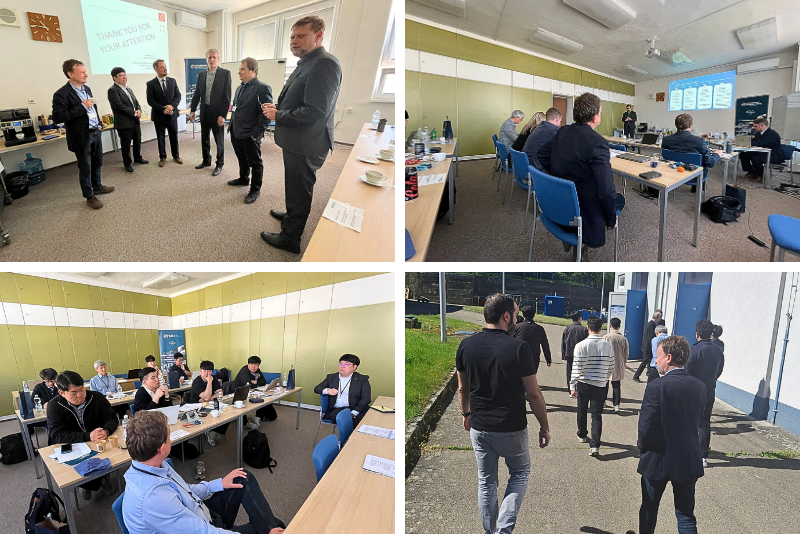
A meeting focused on the reusability of hydrogen fuel cells brought together experts from both the Czech Republic and Korea. Among them was the founder of the Czech deep-tech startup TailorMem, Jan Žitka, Ph.D., who delivered a lecture titled “Degradation of PEM and AEM in hydrogen fuel cells and electrolyzers.” We took the opportunity to ask him for a short interview, which you can find below.
Where do you currently see the greatest opportunities for manufacturing companies that want to enter the field of hydrogen technologies (e.g., materials, components, applications, collaboration with research)?From the perspective of our deep-tech startup focused on PEM and AEM membranes, I see the greatest opportunities in several areas:A key potential lies in the use of hydrogen carriers—especially ammonia and methanol, but also other substances. This stems from practical experience: hydrogen production from renewable sources does not coincide in time with consumption, and the costs of “buffering” (storage and balancing fluctuations) are enormous—significantly higher than the thermodynamic losses associated with converting hydrogen into a carrier and releasing it again. In some cases, it even turns out that the hydrogen carrier can be used directly for a given application, making reconversion unnecessary.For example:
- Ammonia can be used directly as a fuel in engines and turbines, while NOx emissions are now technologically manageable.
- The reduction of iron ore can be carried out not only with coke and hydrogen, but also directly with ammonia.
For manufacturing companies, this means that opportunities lie not only in hydrogen production itself, but also in components, materials, and technologies across the entire value chain—from electrolyzers (membranes, catalysts, bipolar plates), through systems for synthesis and storage of carriers, to end-use applications. Collaboration with research is crucial at this stage—many technologies are still under development, and companies that get involved early will gain a significant competitive advantage.
What practical experience would you share with manufacturing companies that are considering investments in hydrogen technologies—but still hesitate due to technological maturity or return on investment?
Some industrial processes cannot function without hydrogen. Specifically, ammonia synthesis and certain types of (bio)fuels (hydrogenation) are major consumers of hydrogen, and therefore I see a strong opportunity in optimizing hydrogen production for chemical applications. Demand for both commodities is expected to grow, which creates substantial potential in these areas.My recommendations for companies that are hesitating would be:
- Do not wait for “perfect” technological maturity. Hydrogen technologies are evolving rapidly, and late entrants will have to catch up. It is more reasonable to start with pilot projects at a controlled scale.
- Focus on specific industrial applications where hydrogen already makes economic sense today (chemical industry, refineries, metallurgy), rather than investing broadly in the “hydrogen economy” as a whole.
- Evaluate return on investment over a broader horizon—taking into account the development of emissions allowance prices, regulations (CBAM, RED III), and expected subsidy instruments. Calculations based only on current energy prices can be misleading.
- Seek partnerships with research institutions and deep-tech startups—this will accelerate development and reduce initial investment risks.
Hydrogen will not be a universal solution for everything, but in segments where it is irreplaceable, it will become a strategic raw material. Companies that build competencies and supply relationships today will be in a strong position.
We would like to thank Mr. J. Žitka from Company TailorMem for the interview, as well as for his participation and presentation at the event, and we look forward to future opportunities.
The SZÚ Team