




Comprehensive services in areas of testing, inspection, certification and training.
Comprehensive services in areas of testing, inspection, certification and training.

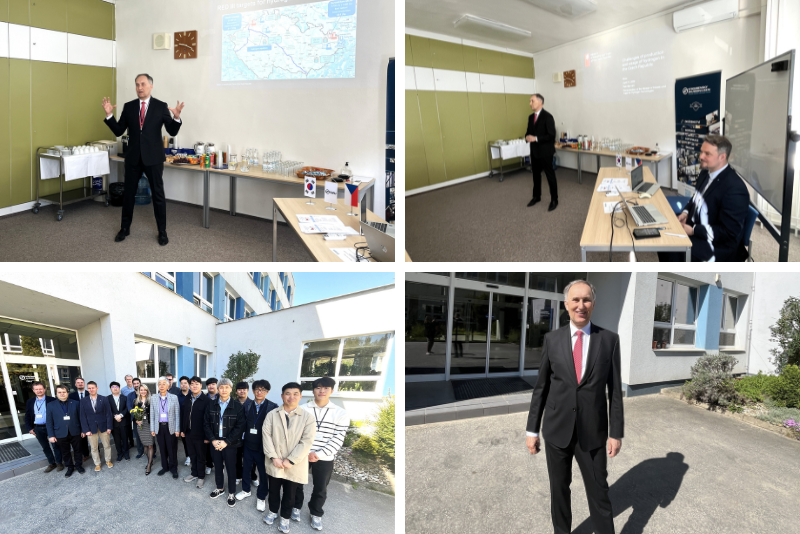
At our technical seminar on the reuse of fuel cells, experts from Korean and Czech companies, research and development, public administration, and universities came together. We took the opportunity to ask Mr. Petr Mervart, Plenipotentiary of Minister of Industry and Trade for Hydrogen Strategies two questions that will certainly be of interest to you as well.
Hydrogen is not only a tool for decarbonization and emissions reduction in industry, energy, and transport. In the Czech Hydrogen Strategy, it also plays an important role in the transformation of industry through research, development, and the production of advanced hydrogen technologies. It is essential to emphasize that hydrogen technologies represent cutting-edge solutions with high added value.
This is precisely the type of industry the Czech Republic has long been striving for — high value-added manufacturing with strong innovation potential and significant export opportunities. It is no coincidence that the regular hydrogen seminar at the International Engineering Fair in Brno in 2025 was titled “From assembly lines to brain hubs.”
Currently, a number of technology companies in the Czech Republic already cover nearly the entire hydrogen value chain. I would like to mention at least some of them, which not only develop but also deliver top-tier products to global markets. These include companies such as TATRA TRUCKS a.s., DEVINN s.r.o., LEANCAT ELECTROLYZERS s.r.o., Valcon International s.r.o., NANO Advanced s.r.o., CYLINDERS HOLDING a.s., Chart Ferox a.s., BAEST Machines & Structures, a.s., 2JCP a.s., and others.
While we do not expect the Czech Republic to fully cover the entire hydrogen value chain, we are actively seeking additional companies that could expand domestic capacities, particularly in the development and production of fuel cells and composite pressure vessels.
One of the areas we aim to further develop, in line with the Hydrogen Strategy, is hydrogen mobility. However, its successful development requires the creation of strong industrial consortia capable of offering transport operators comprehensive solutions — from hydrogen production, through storage and distribution, to vehicle supply and ensuring their long-term reliable operation.
The main message to manufacturing companies is clear: hydrogen technologies are considered a strategic sector with a long-term perspective, supported at both national and European levels. This is not a short-term trend nor an area dependent solely on individual subsidy calls. Hydrogen is firmly embedded in European industrial and energy policies, including those focused on decarbonization, energy security, and strengthening Europe’s technological sovereignty.
At present, we are in the phase of gradually developing the market. The greatest challenge lies in aligning demand with hydrogen production at price levels that are economically viable for both producers and consumers. Under the current very restrictive conditions for renewable hydrogen production — and given the climatic conditions of the Czech Republic — this is not an easy task. It is also clear that the long-term functioning of the market cannot rely solely on subsidy schemes.
The Ministry of Industry and Trade is therefore strongly focused on adapting the regulatory framework for the production and use of renewable and low-carbon hydrogen, in negotiations with the European Commission and other Member States. Our main goal is to promote technological neutrality in hydrogen production, ensure equal conditions for renewable and low-carbon hydrogen, and enable the production of low-carbon hydrogen based on long-term contracts for the supply of low-carbon electricity from nuclear power plants.
It appears that our efforts, coordinated with like-minded EU Member States, are beginning to deliver initial results. The European Commission has announced a technical update of the delegated acts on renewable and low-carbon hydrogen by the end of June, which should reflect some of our proposals. In the Czech context, broader use of electricity from nuclear power plants could significantly improve the economic efficiency of hydrogen projects.
Another area of focus is the support of comprehensive hydrogen projects in transport. Currently, funding schemes are fragmented across several ministries, creating significant administrative and investment challenges for investors. Our goal is to design a program capable of supporting the entire hydrogen value chain — from production and storage to distribution and end-use in vehicles.
We are still at the beginning of this journey, but we believe that such an integrated approach can significantly enhance the efficiency and economic viability of hydrogen projects in the Czech Republic.
We would like to thank Ing. Petr Mervart for the interview, as well as for his participation and presentation at the event, and we look forward to future opportunities.
The SZU Team

News from the world of testing, inspection and certification